













It is true that nurses and social media can mix safely, and there are many upsides to using social media as a nurse, including having the chance to meet and engage with other healthcare professionals worldwide. However, social media for nurses requires a blend of opportunity and responsibility.
The most important social media tips for healthcare professionals come down to four things: protecting patient privacy, maintaining professionalism, being intentional about what you post, and understanding how your online presence can affect your career. Whether you’re a nurse building your career or a student preparing to enter the field, understanding how to navigate social media can help you avoid serious risks while making the most of what these platforms have to offer.

The reality is that your digital footprint is often the first thing an employer or colleague sees about you. While it’s a great way to stay connected with friends or share your nursing school journey, we at Arizona College of Nursing know that the lines between “professional” and “personal” can be blurry. Approaching your healthcare professional online presence with common sense can help you enjoy your time online without having to get nervous about what you’re posting.
Tip 1: Know the Real Risks Before You Post
Understanding the potential consequences of what you post is the first step to engaging online with eyes wide open. As a healthcare professional, you’ve spent too much time and dedication working toward your degree and license to let a single post take it away.
While social media offers a space for self-expression, the consequences of posting something you should not online are real and can include risking your job, licensing issues, and Health Insurance Portability and Accountability Act (HIPAA). violations. According to the American Nurses Association (ANA), “nurses have been fired for posting on social media,” and understanding the stakes can motivate healthcare professionals to post safely online.
Your professional reputation always exists, not just while you are working. Many early in their careers may not realize that state boards and Human Resources departments can act on behavior found on one’s social media. For nurses, social media is unique. The ANA states, “nurses are held to a higher standard, and that’s the same on social media as anywhere else.” If a post reflects poorly on you or the profession entirely, it can have an immediate impact on whether or not you are employed.
Additionally, while you should always take advantage of online privacy settings, they are never guaranteed to work perfectly. According to the ANA’s Principles of Social Media in Nursing, while nurses should understand these settings, “using [them] does not guarantee safety.” It takes just one person to see a private post, screenshot it, and make it available to the public. Once something is posted, you lose control. As a healthcare professional with an online presence, you must remember that once you post something online, it becomes public record.
Tip 2: Think Twice Before Posting Anything Work-Related
Another important social media tip for healthcare professionals is to refrain from posting anything about your workplace entirely. This means keeping patient-specific posts off your feed as well as critiques about the workplace.
The ANA suggests that “if you want to ensure you stay in compliance with your organization’s guidelines, it may be a good idea to make no mention of your workplace at all.”
Refrain from venting about employers or coworkers, sharing details about workplace situations, and posting content that could reflect poorly on your professional character. Even if you don’t name your facility, what you’re wearing or your location can make it easy to identify where you are and who you are talking about.
Remember that your online persona is an extension of you, and your future employers can see it. If a recruiter finds you previously spoke negatively about your place of employment or posted work-related drama during their search of you, they may assume you will bring the same energy to your new job. By keeping your account focused on your life outside of the workplace, you can make sure what you do online does not accidentally cost you your job.
It’s also essential to know the privacy settings on every platform that you use. Whether you are on Facebook, Instagram, TikTok, or something else, you should try to learn everything about the app and how your data is shared. Even with the best security systems enabled, nurses on social media should not post something they wouldn’t want everyone to see.

Despite its name, privacy settings do not always guarantee privacy. It only takes one person screenshotting your post or forwarding a message to someone outside of your intended circle. Once your content is captured by someone else’s device, you lose all control over its distribution.
When managing your healthcare professional online presence, the safest approach is to assume that every post is permanent and potentially public, regardless of what your settings say.
Tip 3: Understand what Patient Privacy Means Online
Protecting the people we care for is at the heart of what nurses do, and knowing the nuances of HIPAA and social media goes with that. A common misconception among social media tips for nurses is thinking that as long as you do not use a name, you are not violating privacy. However, even if you have the best intentions, you may accidentally share something that is in violation of HIPAA.
HIPAA defines Protected Health Information (PHI) as individually identifiable information which includes any health information relating to a patient’s condition, the past, present, or future provision of healthcare, or payment thereof. If someone is able to connect the dots on who a person is based on a photo, video, or story, it is a violation.
According to the American Association of Critical Care Nurses, “[s]ometimes, nurses accidentally share PHI. It can be as simple as discussing patient care cases online or not blurring patient information on a computer screen in the background of a posted photo. Employers, regulatory organizations and the legal system can and will hold individuals accountable for those posts, whether accidental or not.”
Additionally, the ANA advises against connecting with patients or their families online. Sharing PHI over social networks is never completely safe. If you were friends before they were your patient, you should “avoid discussing or sharing information about your nurse-patient relationship over the internet.”
As a best practice, healthcare workers should not film themselves at their place of work to avoid any potential HIPAA concerns.
Tip 4: Be Intentional About How You Present Yourself
You don’t have to stay off social media entirely, but you should be intentional with what you post. If you do want to post, choose a tone that reflects who you are as a professional and use your platform to support your career.
Knowing and following your organization’s social media policy makes for a safe online presence. Most places have specific guidelines that lay out exactly what you can or cannot say about your organization or role. Familiarize yourself with your employer’s social media policy and adhere to it. Some organizations even have rules about identifying yourself as an employee, so it could help to add a disclaimer to your social media bio.
The ANA says, “[i]f you do list the name of your employer, you may want to add a sentence to your bio explaining that your opinions are your own, such as, ‘The views expressed here are my own and do not reflect the views of my employer.’”

At Arizona College of Nursing, we even have our own group of students who model how to represent the nursing profession safely called the Social Scrub Squad. They work within our College community to highlight life as a nursing student while ensuring that every post remains compliance approved and follows all guidelines. Checking your employee handbook or your school’s guidelines is a crucial first step for anyone in or going into the healthcare profession.
Additionally, decide how much of your life you want to be visible online. Some nurses choose to have a separate professional social media page where they share healthcare or popular studies while keeping their personal life on a private account. Drawing a clear line between professional and personal content can help you manage your online presence.
For nurses who use social media to educate others, stick to evidence-based information. You can become a trusted resource for your community via your social media page by debunking medical myths, sharing the positive sides of nursing, and providing citations to back up what you say. By doing this, you may even catch the eye of potential employers who value leadership and education. These social media tips for healthcare professionals can help keep your digital footprint reflecting the professional you are.
Maintaining your professionalism is a 24/7 commitment that does not end when your shift is over. Nurses are trusted individuals, and your online presence should reflect that. By prioritizing these social media tips, you can make sure you are using your healthcare professional online presence in the best way.
Starting Your Own Nursing Journey
At Arizona College of Nursing, we are committed to helping our students navigate everything from clinical skills to the professional wisdom needed to thrive in todays’ nursing profession. If you are ready to take the next step in your nursing journey, visit our website, check out our nursing programs, or head over to our blog to learn more about how to thrive in today’s modern healthcare landscape.
Start Your Future in Nursing Today

If you’re considering a career as a registered nurse (RN), Arizona College of Nursing is here to help you pursue your dream. Our BSN program enables you to earn a Bachelor of Science in Nursing in just 3 years or less with qualifying transfer credits. We’ve helped hundreds of students to earn a BSN degree and enter the nursing profession – and we’re ready to support you on your path to becoming an RN.
Why Choose Arizona College of Nursing?
- Earn a BSN degree in 3 years or less with eligible transfer credits
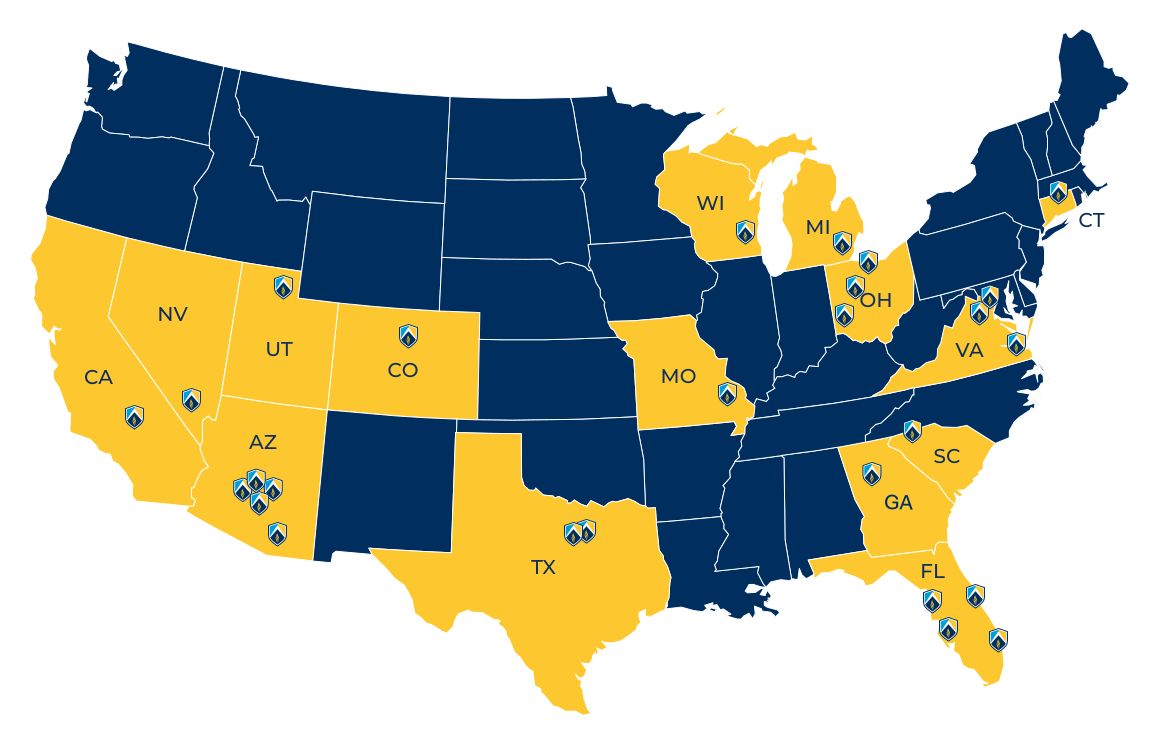
- Campus locations throughout the US
- Night classes for general education courses
- Hybrid Online/In-Person format for general education classes
- Nursing education is all we do
- CCNE-Accredited Program*
- NCLEX-RN success coaches and exam preparation class
- Financial aid available to those who qualify
Discover Your Path to a Career in Nursing
Information in this post is accurate as of August 24, 2012.
*The Bachelor of Science in Nursing (BSN) degree program at Arizona College of Nursing is accredited by the Commission on Collegiate Nursing Education (https://www.aacnnursing.org/). All Arizona College of Nursing and Arizona College campuses are institutionally accredited by the Accrediting Bureau of Health Education Schools (https://www.abhes.org/), a U.S. Department of Education-recognized accrediting agency.