












An Overview of Modern Dental Technology
Dental Assistants are responsible for a wide variety of on-the-job tasks, with duties including everything from making patients as comfortable as possible in the dentist’s chair, to obtaining and maintaining patient records, and everything in between. As you begin your career in Dental Assisting, it is important to familiarize yourself with the various tools and equipment you will be using on a day-to-day basis.
As a Dental Assistant, you will be responsible for operating and sterilizing a range of sophisticated equipment and instruments. Many dental tools are used to keep the patient’s mouth dry and clear of debris to aid the dentist’s visibility and make the patient more comfortable. Most Dental Assistant responsibilities do not include using any invasive equipment, like drills. The most commonly used tools include the suction hose, high-volume evacuator, and air-water syringe.
Dental Assistants use the suction hose (also commonly referred to as a saliva ejector or spit-suction device) to help keep the patient’s mouth clean and dry. This instrument is typically white in color and consists of a flexible tube attached to a handle. The suction hose tool removes saliva and tooth particles that may be loosened by the dentist’s drill, improving the dentist’s visibility.
While the suction hose is used for saliva and small debris, the high-volume evacuator is a larger version of the suction hose and is used to vacuum away larger debris. This device looks similar to a suction hose, only wider. This tool is essential during oral surgery, root canals, and fillings, and prevents any pieces that are dislodged during a procedure from becoming a choking hazard.
The air-water syringe has a long, thin tube from which both air and water are expelled. The air-water syringe is used to inject small streams of water or air into the patient’s mouth to clean precise spots or to break free small pieces of a tooth.
To learn more about Dental Assisting and how you can get started in a career in oral health, contact Arizona College.
Information in this blog post is accurate as of January 14, 2013.
Start Your Future in Nursing Today

If you’re considering a career as a registered nurse (RN), Arizona College of Nursing is here to help you pursue your dream. Our BSN program enables you to earn a Bachelor of Science in Nursing in just 3 years or less with qualifying transfer credits. We’ve helped hundreds of students to earn a BSN degree and enter the nursing profession – and we’re ready to support you on your path to becoming an RN.
Why Choose Arizona College of Nursing?
- Earn a BSN degree in 3 years or less with eligible transfer credits
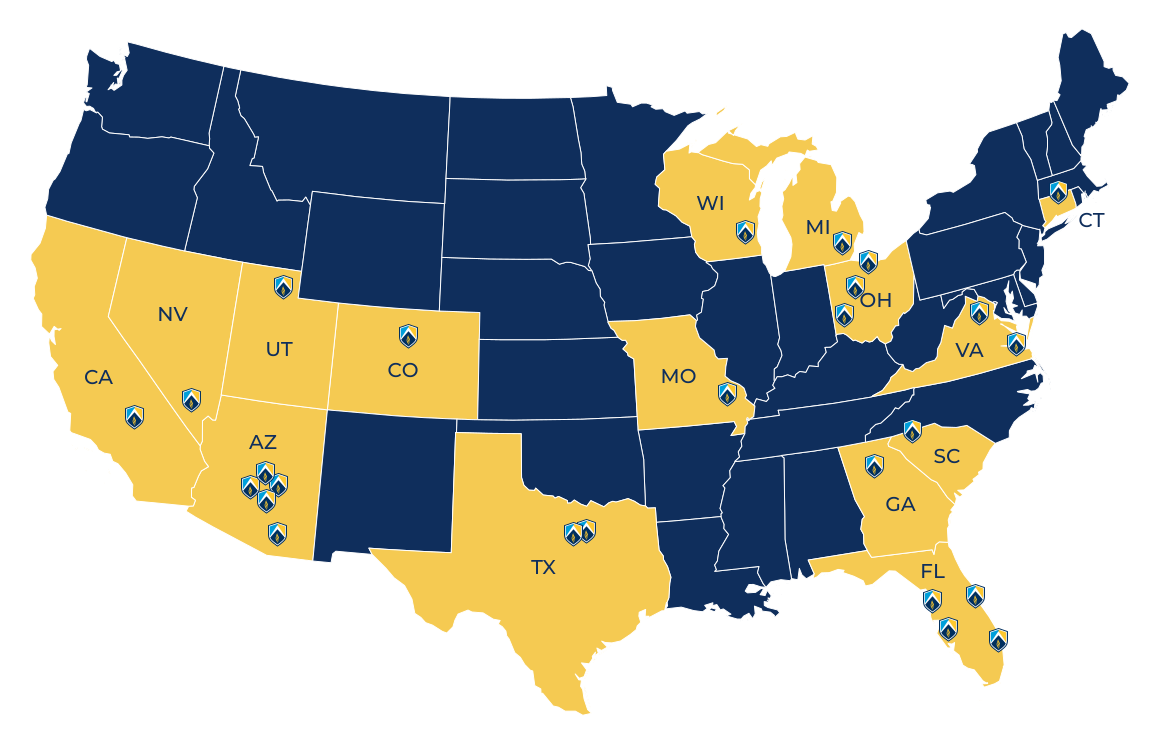
- Campus locations throughout the US
- Night classes for general education courses
- Hybrid Online/In-Person format for general education classes
- Nursing education is all we do
- CCNE-Accredited Program*
- NCLEX-RN success coaches and exam preparation class
- Financial aid available to those who qualify
Discover Your Path to a Career in Nursing
Information in this post is accurate as of January 14, 2013.
*The Bachelor of Science in Nursing (BSN) degree program at Arizona College of Nursing is accredited by the Commission on Collegiate Nursing Education (https://www.aacnnursing.org/). All Arizona College of Nursing and Arizona College campuses are institutionally accredited by the Accrediting Bureau of Health Education Schools (https://www.abhes.org/), a U.S. Department of Education-recognized accrediting agency.