













Allied Health Professions Week 2014
Every year, the health care community desires to create awareness for particular health care related professions, including Allied Health. November 3rd-9th, 2014, is a week dedicated to honoring all Allied Health Professionals. This event honors the more than 3 million health care providers working in more than 80 allied health professions. It promotes the celebration of allied health careers by providers, educators, and allied health accreditors.
Who are Allied Health Professionals? Allied Health Professionals provide patient care, which including the medical, dental and pharmacy fields. They work within a team to make the health care system function effectively and efficiently by providing a wide range of diagnostic, technical, therapeutic, and direct patient care and support services. These professionals are crucial to the health care providers they support and the patients they tend. It is estimated that Allied Health Professionals make up approximately 60% of the health care workforce.
What are some important traits for Allied Health Professionals to demonstrate?
- Communication-Allied Health Professionals communicate detailed information on a daily basis with the patient directly or other health care team members. Good communication skills, both verbal and in writing, are imperative to ensure the best patient care is given.
- Passion– Patients and team members often observe more from body language than spoken language, so make sure your passion for your field is ignited. A positive attitude and passionate person are often required for a satisfying health care career.
- Empathy-Understanding and relating to a patient’s feelings are important in making patients feel comfortable. When health care professionals respond empathetically to a patient’s feelings, the patient is more likely to follow and stay on their treatment plans. An Allied Health Professional who is empathetic will assist on reducing their patient’s anxiety about their visit.
- Knowledge– Completing a degree or diploma from an accredited institution is one way to learn about work within the field. Seeking additional certification within the field of study is another way to further skills and knowledge. Completing continuing education courses, networking, joining a field related professional organization, or volunteering could increase knowledge within a profession. If an Allied Health Professional is knowledgeable about her profession, she will more likely have a long lasting and rewarding career.
At Arizona College, our programs are designed with Allied Health Professions in mind. Our programs are accredited through the Accrediting Bureau of Health Education Schools (ABHES). We offer many exciting programs that include both lecture and laboratory courses for the ultimate hands on learning experience. Our programs include: Medical Assisting, Dental Assisting, Massage Therapy, Pharmacy Technician, and Medical Billing and Coding. With two conveniently located campuses in Glendale and Mesa, AZ, you can find a campus near you to begin your Allied Health training today
Information in this blog post is accurate as of October 27, 2014.
Start Your Future in Nursing Today

If you’re considering a career as a registered nurse (RN), Arizona College of Nursing is here to help you pursue your dream. Our BSN program enables you to earn a Bachelor of Science in Nursing in just 3 years or less with qualifying transfer credits. We’ve helped hundreds of students to earn a BSN degree and enter the nursing profession – and we’re ready to support you on your path to becoming an RN.
Why Choose Arizona College of Nursing?
- Earn a BSN degree in 3 years or less with eligible transfer credits
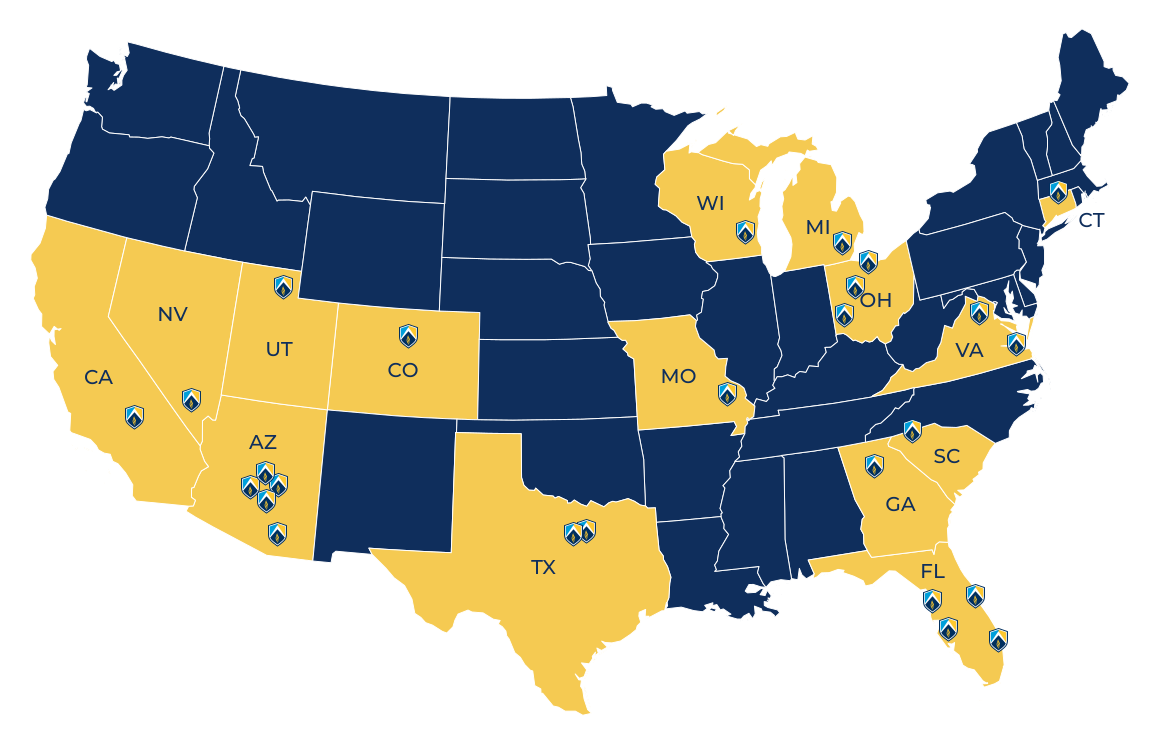
- Campus locations throughout the US
- Night classes for general education courses
- Hybrid Online/In-Person format for general education classes
- Nursing education is all we do
- CCNE-Accredited Program*
- NCLEX-RN success coaches and exam preparation class
- Financial aid available to those who qualify
Discover Your Path to a Career in Nursing
Information in this post is accurate as of October 27, 2014.
*The Bachelor of Science in Nursing (BSN) degree program at Arizona College of Nursing is accredited by the Commission on Collegiate Nursing Education (https://www.aacnnursing.org/). All Arizona College of Nursing and Arizona College campuses are institutionally accredited by the Accrediting Bureau of Health Education Schools (https://www.abhes.org/), a U.S. Department of Education-recognized accrediting agency.