











Landing a nursing job interview is a real milestone. It means your resume stood out, and now you have the chance to show who you are as a future nurse. But knowing how to prepare for nursing interview questions, present yourself professionally, and follow up with confidence can make a significant difference in how you perform. This post covers the practical tips you need to walk into your interview prepared and leave a strong impression.

What makes a nursing job interview different from other interviews?
Nursing interviews go beyond the standard “tell me about yourself” format. Hiring managers in healthcare want to understand how you think, how you act under pressure, and how you approach patient care. That means you can expect questions that ask you to speak from real experience rather than describe what you would theoretically do. Knowing this going in helps you prepare the right way.

What types of questions are commonly asked in nursing interviews?
Nursing interview questions often fall into a few common categories: behavioral questions, clinical scenario questions, and questions about your nursing philosophy. Knowing what to expect in each area will help you prepare more focused, confident answers.
Behavioral questions

Behavioral questions ask you to describe how you handled specific situations in the past. Common examples include questions about managing a conflict with a colleague, dealing with a difficult patient, or responding to a mistake you made at work. Healthcare employers rely on these questions because they reveal how a candidate actually performs across a range of workplace situations, not just what they say they would do.
A widely used framework for answering behavioral questions is the STAR method: Situation, Task, Action, and Result. Walking through each element keeps your answer focused and gives the interviewer a complete picture of how you handled a situation, from the context that prompted it to the outcome you achieved.
Situational and clinical scenario questions
Clinical scenario questions present you with a hypothetical patient care situation and ask how you would respond. These questions assess your clinical reasoning, critical thinking, and decision-making under pressure. Your clinical training is a significant asset here. Drawing on hands-on experience and clearly explaining your reasoning will carry more weight than a general response.
Questions about your nursing philosophy
Many interviewers will ask why you chose nursing or what patient-centered care means to you. These questions are an opportunity to share your genuine motivation in a specific, grounded way. A strong answer connects your values to real moments or experiences, whether that is a volunteer role, a personal encounter with healthcare, or a clinical rotation that shaped your perspective.

How should you prepare for a nursing job interview?
Solid preparation makes a real difference in how you show up. These steps are tailored to what nursing interviews specifically require.
- Review your clinical experiences. Think through patient care situations you have navigated, difficult moments from your rotations, and examples that show how you handle pressure or solve problems at the bedside. These are the stories your behavioral answers will draw from.
- Research the facility and unit. Nursing roles vary significantly depending on the setting. A trauma unit, a pediatric floor, and an outpatient clinic each have different patient populations, acuity levels, and team dynamics. Knowing something specific about where you are interviewing helps you speak to the role more precisely.
- Practice answering out loud using the STAR method. As noted in the section above, most nursing interview questions are behavioral. Walking through Situation, Task, Action, and Result out loud before your interview helps you stay focused and concise when it counts.
- Think through how you would answer questions about your nursing philosophy. Interviewers in healthcare often ask candidates why they chose nursing and what patient care means to them. Having a specific, honest answer ready rather than a vague one will serve you better in the room.
- Prepare a few questions to ask the interviewer. Coming with your own questions signals genuine interest and gives you useful information about the role.

What should you wear to a nursing interview?
How you present yourself is part of your preparation. For most nursing job interviews, professional attire is the right default choice. While scrubs are standard workwear on the floor, they are generally not recommended for interviews at hospitals or larger healthcare facilities, where a more polished appearance signals that you take the process seriously.
For most staff-level nursing positions, business casual or business professional attire is appropriate. Think clean, well-fitted clothing in neutral tones: dress pants, a button-down shirt or blouse, and closed-toe shoes. If you are interviewing for a management or administrative role, lean toward business formal. When in doubt, it is better to be slightly overdressed than underdressed.
That said, some settings vary. Certain clinics or outpatient environments may have a more relaxed culture, and in rare cases an employer may ask you to wear scrubs, particularly if the interview includes a hands-on skills component. If you are unsure what is expected, it is always appropriate to ask your contact ahead of time.


What questions should you ask at the end of a nursing interview?
Asking thoughtful questions at the end of an interview shows genuine interest and gives you the information you need to evaluate the role. An interview is a two-way conversation, and the questions you ask say something about how seriously you are approaching the opportunity.
The right questions will vary depending on the role, the setting, and what matters most to you. As a general strategy, aim for questions that help you understand the team culture, what success looks like in the position, and whether the environment is one where you can grow. Avoid questions that could be easily answered by a quick look at the facility’s website, and save compensation and benefits discussions for later in the process. The suggestions below are a starting point, not a script.
Strong questions to consider include:
- How does this role differ day-to-day from other nursing positions at this facility?
- How does the team handle high-acuity situations or surges in patient volume?
- How does the team approach professional development for nurses who are earlier in their careers?
- How long have you been with the organization, and what has kept you here?
- What would you want a new nurse in this role to accomplish in their first 90 days?
Avoid asking about salary or benefits at this stage. Those conversations often happen later in the hiring process.

How do you follow up after a nursing job interview?
Send a thank-you note within 24 hours of your interview. It is a simple step that many candidates skip. Keep it short, genuine, and specific to your conversation. Reference something that came up during the interview, briefly restate your interest in the role, and thank the interviewer for their time. Email is perfectly acceptable, and a handwritten note sent promptly can make a strong impression as well.
If the interviewer shared a timeline for their decision and you have not heard back by that date, a brief, courteous follow-up email is appropriate.
Preparation and confidence go hand in hand. The more clearly you understand what nursing job interviews involve and the more specifically you practice, the more naturally your skills and character will come through in the room. Ready to start building the clinical foundation and hands-on experience you need to pursue your nursing career? Talk to an admissions advisor to learn more about our three-year BSN program.
Start Your Future in Nursing Today
If you’re considering a career as a registered nurse (RN), Arizona College of Nursing is here to help you pursue your dream. Our BSN program enables you to earn a Bachelor of Science in Nursing in just 3 years or less with qualifying transfer credits. We’ve helped hundreds of students to earn a BSN degree and enter the nursing profession – and we’re ready to support you on your path to becoming an RN.
Why Choose Arizona College of Nursing?
- Earn a BSN degree in 3 years or less with eligible transfer credits
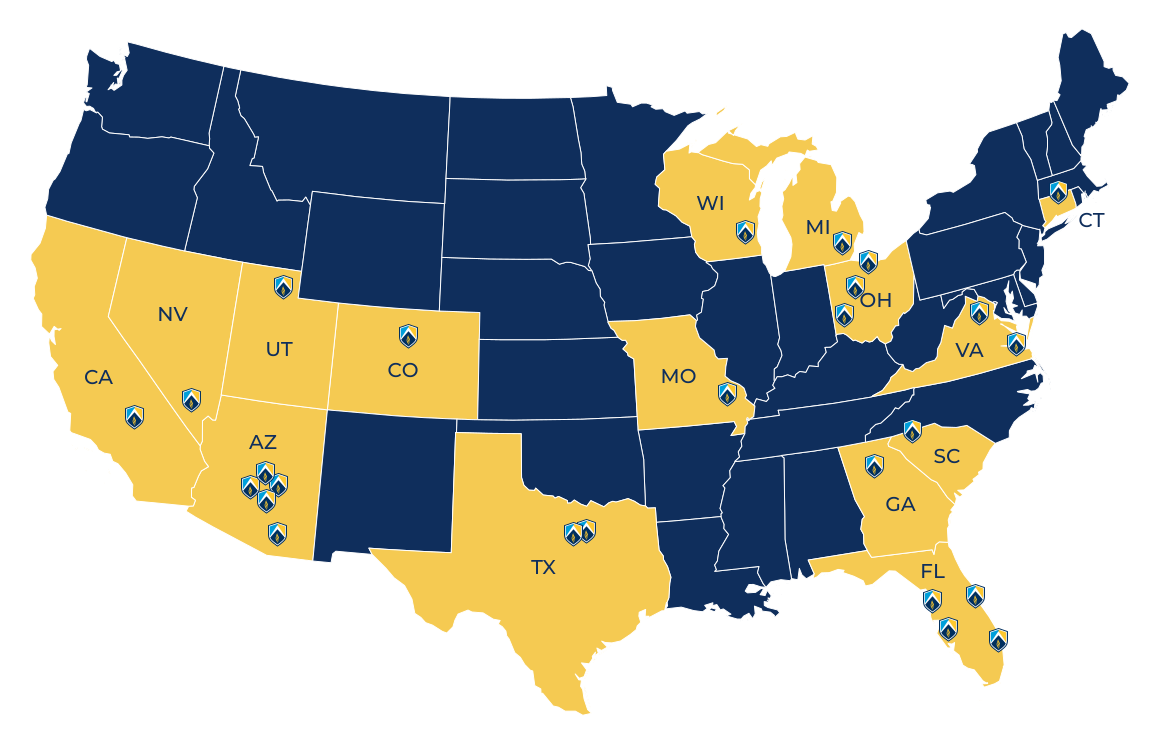
- Campus locations throughout the US
- Night classes for general education courses
- Hybrid Online/In-Person format for general education classes
- Nursing education is all we do
- CCNE-Accredited Program*
- NCLEX-RN success coaches and exam preparation class
- Financial aid available to those who qualify
Discover Your Path to a Career in Nursing
Information in this post is accurate as of March 30, 2026.
*The Bachelor of Science in Nursing (BSN) degree program at Arizona College of Nursing is accredited by the Commission on Collegiate Nursing Education (https://www.aacnnursing.org/). All Arizona College of Nursing and Arizona College campuses are institutionally accredited by the Accrediting Bureau of Health Education Schools (https://www.abhes.org/), a U.S. Department of Education-recognized accrediting agency.